
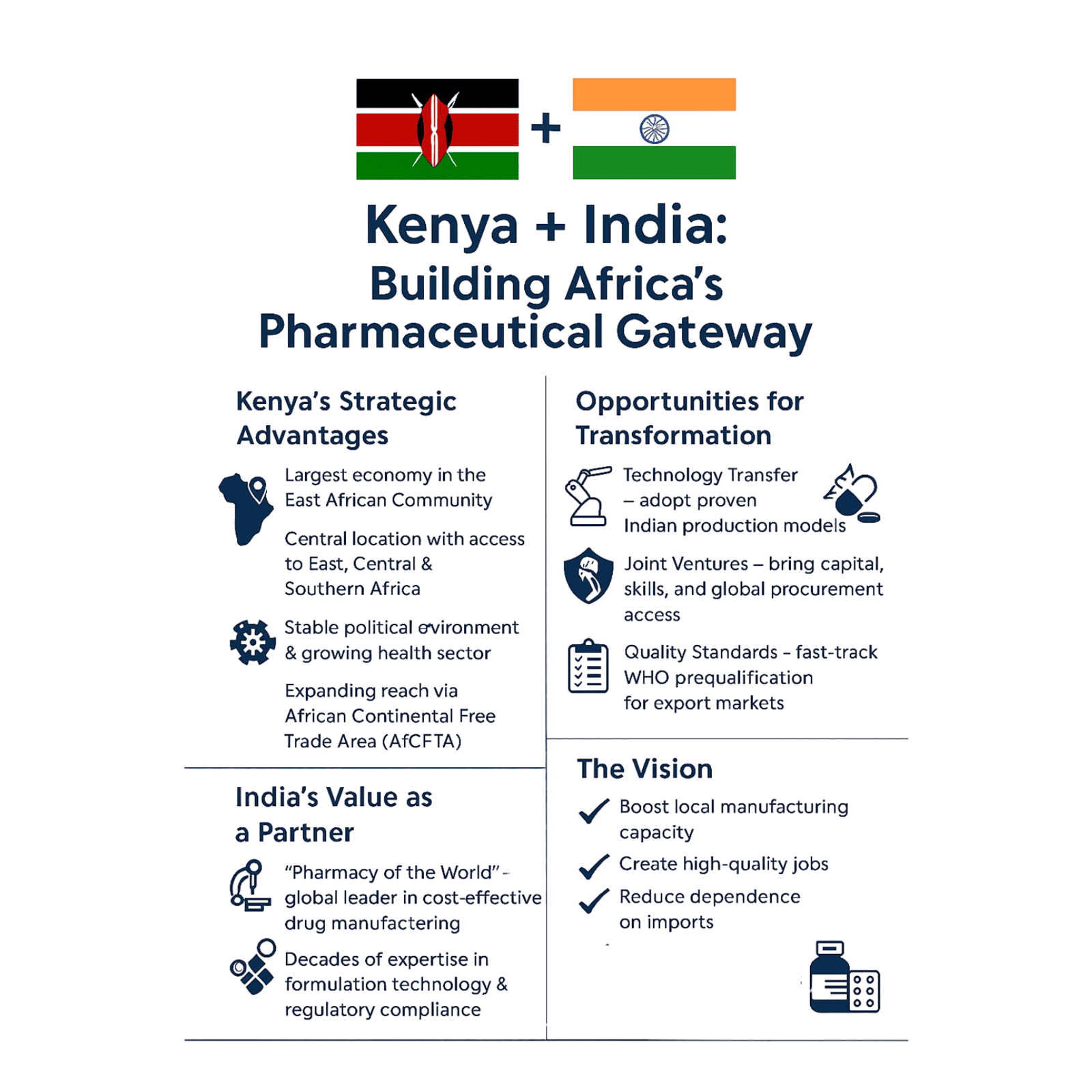
Kenya has a credible opportunity to emerge as a hub for pharmaceutical manufacturing in Africa with India’s support, but success will depend on deliberate policy choices, targeted investments, and robust partnerships. India’s status as the “pharmacy of the world” positions it as an ideal strategic partner for Kenya, bringing decades of expertise in cost-effective, large-scale drug manufacturing, formulation technology, and regulatory compliance.
Kenya already holds a regional advantage: it is the largest economy in the East African Community, has a relatively stable political environment, a growing health sector, and a central location with access to marts in East, Central, and parts of Southern Africa. The African Continental Free Trade Area (AfCFTA) further expands the potential reach for locally manufactured medicines. Coupled with an improving regulatory framework under the Pharmacy and Poisons Board and a push for Good Manufacturing Practices (GMP) compliance, Kenya can be well-placed to supply essential medicines to the continent.
Indian support could accelerate this transformation in several ways. First, technology transfer agreements can enable Kenyan facilities to adopt tried-and-tested Indian production models for generics, vaccines, and biosimilars. Second, joint ventures between Indian pharma companies and Kenyan firms can bring capital investment, skilled training, and ready access to international procurement networks. Third, India’s experience in navigating global quality certifications (such as WHO prequalification) can help Kenyan plants meet export standards quickly, opening channels to donor-funded procurement programs like the Global Fund and Gavi.
However, to truly become a continental hub, Kenya must address certain constraints. Local manufacturing costs remain higher than in India due to power costs, raw material import dependence, and limited economies of scale. Streamlined regulatory approvals, tax incentives for manufacturers, stronger protection of intellectual property, and investments in pharmaceutical R&D are necessary to compete with established suppliers. Skilled workforce development—through partnerships between Kenyan universities and Indian pharma training institutes—will also be critical to sustaining operations and innovation.
If these conditions are met, a Kenya–India partnership could mirror the success of India’s collaboration with other emerging economies, creating a mutually beneficial relationship: Kenya gains manufacturing capacity, jobs, and reduced dependence on imports, while India secures a strategic production base inside Africa, close to growing consumer markets and major health procurement programs. In effect, Kenya could become not just a regional supply point, but Africa’s pharmaceutical gateway—provided the collaboration is executed with scale, quality, and speed.
The blog post has been written by Mr. T.R.M. Ramamurthy