13th September 2025
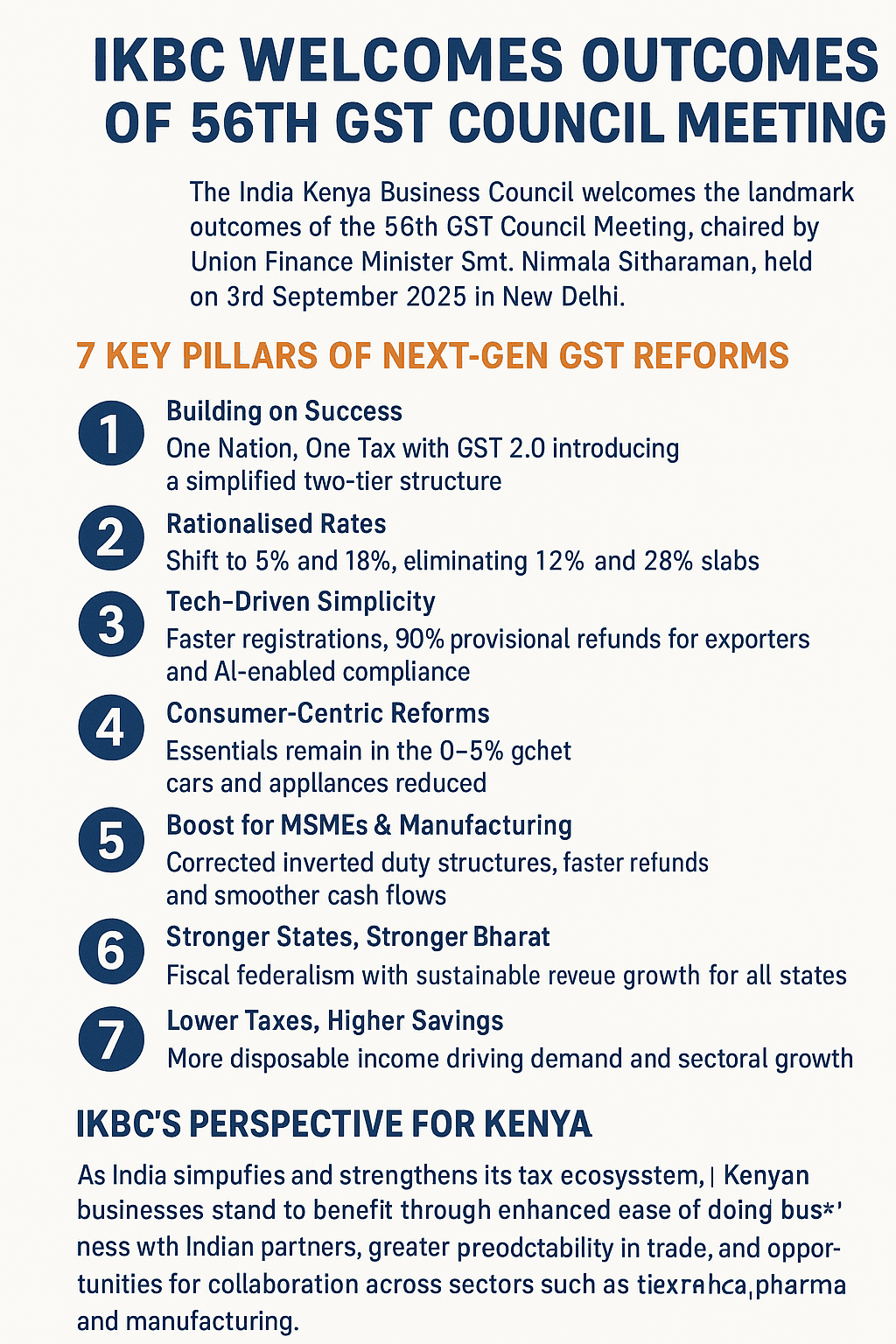
The India Kenya Business Council (IKBC) welcomes the landmark outcomes of the 56th GST Council Meeting, chaired by Union Finance Minister Smt. Nirmala Sitharaman, held on 3rd September 2025 in New Delhi.
The meeting laid out 7 key pillars of Next-Gen GST reforms that will not only strengthen India’s economy but also have a far-reaching impact on global trade and business partners like Kenya. The reforms underscore the government’s commitment to simplifying taxation, empowering businesses, and fostering sustainable growth.
Highlights of the 7 Pillars of Next-Gen GST Reforms:
1️⃣ Building on Success – One Nation, One Tax with GST 2.0 introducing a simplified two-tier structure.
2️⃣ Rationalised Rates – Shift to 5% and 18%, eliminating 12% and 28% slabs, reducing disputes and ensuring liquidity.
3️⃣ Tech-Driven Simplicity – Faster registrations, 90% provisional refunds for exporters, and AI-enabled compliance.
4️⃣ Consumer-Centric Reforms – Essentials remain in the 0–5% bracket, with cars and appliances reduced from 28% to 18%.
5️⃣ Boost for MSMEs & Manufacturing – Corrected inverted duty structures, faster refunds, and smoother cash flows.
6️⃣ Stronger States, Stronger Bharat – Fiscal federalism with sustainable revenue growth for all states.
7️⃣ Lower Taxes, Higher Savings – More disposable income driving demand and sectoral growth.
Key Outcomes:
- Inverted duty structures on fertilizers, fabrics, and other essential goods have been corrected, offering relief to businesses and consumers alike.
- Implementation begins on 22nd September 2025, except for rate changes on tobacco and related products.
On 15th August 2025, during India’s 79th Independence Day, Prime Minister Shri Narendra Modi had announced the government’s vision for Next-Generation GST reforms. The 56th Council meeting marks a decisive step in translating this vision into reality.
IKBC’s Perspective for Kenya:
As India simplifies and strengthens its tax ecosystem, Kenyan businesses stand to benefit through enhanced ease of doing business with Indian partners, greater predictability in trade, and opportunities for collaboration across sectors such as textiles, pharma, and manufacturing. These reforms will further deepen India–Kenya economic ties, aligning with IKBC’s mission to strengthen bilateral trade and investment flows.
About IKBC:
The India-Kenya business council is a bridge to exchange information on business, import- The India-Kenya Business Council (IKBC) serves as a bridge for the exchange of information on business opportunities, import-export, joint ventures, technology transfers, contract manufacturing tie-ups, and investments across diverse sectors in both countries.
The Council actively works to promote business growth and investment by organizing initiatives that create awareness, foster collaboration, and build a supportive environment for stronger bilateral trade and economic engagement.
India Kenya Business Council